AUDIT: Agility / Figure AI: The Titanium Arbitrage: Auditing Humanoid CAPEX

Listen on
Listen (episode)SpotifyApple PodcastsRSS
The Cassandra Files — forensic audio drama. Katie audits the books, Marcus kills the spin, Killian opens the file. About · Latest · Themes
A warehouse worker on the night shift balances a heavy industrial floor buffer with one knee, quickly eating a cold egg sandwich out of a plastic wrapper before the foreman returns. This tableau represents an undeniable, friction-heavy reality: the human survival instinct. It is a biological imperative driven by caloric deficit, the threat of eviction, and the relentless demands of landlords. Bipedal robots do not have landlords. They do not possess a survival instinct. Yet, the current capitalization of the humanoid robotics sector operates on the absolute delusion that a titanium chassis can seamlessly replicate this complex, instinctual labor environment.
Agility Robotics and Figure AI are currently selling the illusion of a one-to-one human replacement. Backed by staggering valuations and aggressively optimistic projections, the industry promises to engineer modern logistics out of the farm-cycle decay of warehouse labor, where the human body simply breaks under repetitive load. But beneath the polished prospectus filings and the carefully curated kinematic performance indicators lies a profound structural fragility. The humanoid robotics market is not an engineering miracle on the verge of ubiquity; it is a labor arbitrage play defined by massive capital expenditure (CAPEX), masking severe deficits in physical dexterity and systemic latency.
The Financial Fiction of One-to-One Replacement
The logistics sector has officially entered the structured liquidity phase of the automation hype cycle. Figure AI is actively commanding a theoretical thirty-nine billion dollar valuation, driven by chief executive Brett Adcock’s public projection of ten billion humanoids deployed by the year 2030. When cross-referenced with recent Churchill Capital SPAC filings, this valuation reveals itself not as a reflection of current technological capability, but as an anachronistic delusion. A Special Purpose Acquisition Company is simply a structured liquidity vehicle allowing private entities to bypass traditional initial public offering friction and access essential capital. The capital is flowing, but it is effectively a liquidity extraction play dressed up as inevitable innovation.
The institutional reality is that the physical metal of the humanoid chassis is rapidly becoming a complete afterthought. Consider the recent market maneuvers by Unitree, which slashed the unit price of its G1 deployment to thirteen thousand, five hundred dollars—a price point lower than a depreciated used sedan. The structural implication of this drastic price cut is that the hardware itself is essentially worthless. The bipedal chassis operates as a loss leader, specifically designed to trap enterprise clients in proprietary cloud ecosystems like the Agility Arc.
Robotics firms are willing to distribute the physical units at a loss so they can extract perpetual capital from logistics companies via a monthly compute tax. The sheer volume of capital required to sustain this model is staggering. It requires forty-four thousand hours of compute cost on NVIDIA infrastructure just to train one baseline model to pick up a cardboard box without crushing it. Every dollar of venture capital is being liquefied and burned simply to keep the data centers running, proving that the future of automation is not a hardware revolution, but a highly leveraged data play.
Latency and the Architecture of Failure
From an architectural standpoint, the transition from simulated physics engines to the concrete reality of a factory floor exposes severe systemic vulnerabilities. Companies like GXO Logistics are currently running Agility fleets on the warehouse floor, but these pilot programs reveal a twenty-three percent manual intervention rate. In practical terms, this means a human operator must remotely step in and reset the bipedal chassis one out of every four times it attempts a task. While industry executives frame this twenty-three percent as an acceptable engineering baseline, it is actually a catastrophic bleed of operational efficiency.
The central mechanism of this failure is teleoperation latency. The entire extraction model relies on a brutal one-hundred-millisecond latency threshold. If the connection to the Agility Arc cloud drops on the factory floor, the whole bipedal unit simply freezes or destabilizes.
Consider the precise mechanics of a silk scarf catching in the gears of a Canary Wharf escalator. When a pedestrian, distracted by a mobile phone, fails to notice the fabric being pulled into the machinery, survival depends entirely on the escalator’s mechanical emergency stop engaging before the fabric tightens around the neck. A humanoid robot lacks this biological flinch reflex. It cannot rely on a remote cloud server, delayed by network latency, to tell it when to stop crushing an object or when to brace for a catastrophic impact. Latency is fundamentally lethal when heavy moving parts are involved.
To obscure these architectural failures, companies flood investor channels with kinematic performance indicators, boasting about measuring radians per second on the Figure 03 chassis. This is a strategic information filtering tactic. Measuring radians per second isolates joint actuation speed from holistic chassis navigation, serving as a diagnostic smokescreen to hide the fact that the unit cannot reliably lift a standard automotive tote. The algorithms are learning, but the models are burning billions in compute just to teach a metal skeleton not to fall over its own feet.
Biological Bottlenecks and the Reality of Friction
The biological bottleneck of human labor is routinely cited as the primary catalyst for robotic integration, yet the mechanical replacements suffer from their own debilitating environmental fragilities. Down on the factory floor at the BMW Spartanburg plant, the reality of physical friction dismantles the prospectus. In this high-density, dynamic environment, the Figure 03 chassis is currently running twelve percent slower than its human counterpart. Enterprise clients are paying for a cutting-edge humanoid and receiving an incredibly expensive, highly fragile statue that seizes up in the South Carolina humidity.
The thermal degradation of these units is severe. Joints seize after seventy-two hours of continuous operation because simulated physics engines cannot replicate the exact particulate dust, ambient moisture, and thermal stress of a live automotive assembly line. This thermal reality evokes the suffocating environment of a sealed server room in Sedona—six hours trapped inside a locked box with the heat pressing down like a wet blanket, a turquoise ring hot to the touch, and the acrid tang of overheated capacitors filling the air. When that identical thermal stress is applied to a bipedal unit attempting to navigate a warehouse floor, the Agility Digit v5 destabilizes the second it pushes past three miles per hour. Deploying these units before the thermal degradation is fully mapped is an engineering collapse masquerading as an iterative stress test.
Furthermore, the deployment of these units is heavily restricted by federal safety regulations. For a robot to operate safely alongside human workers without the use of industrial caging, it must adhere to the OSHA 80-Newton force limit. To contextualize this metric, an eighty-Newton force limit is roughly equivalent to the physical impact of an overly enthusiastic golden retriever. This regulatory ceiling fundamentally neuters the heavy-lifting capacity required for actual warehouse logistics. It renders the bipedal chassis an underpowered mechanism, legally barred from exerting the force necessary to replace the human workers it was designed to supplant.
The Cultural Autopsy of the Factory Floor
The cultural residue of this technological shift reveals a profound obsolescence, an algorithmic embalming of labor that leaves behind only phantom pain and depreciated hardware. The history of automation is already littered with obsolete code and forgotten milestones. In 2024, the foundational ostrich algorithm V1 was coded to the frantic tempo of Pulp’s Disco 2000, the programmer's fingers seizing up under candlelight as CPU cycles dictated the rhythm of early bipedal balance. Today, that legacy feels like an ancient artifact, the phantom pain of a system that fractured the moment it met the physical world.
Watching the ozone rise from the pavement in the Tokyo rain, clutching a red binder full of depreciated hardware specifications, one witnesses the immediate premonition of scrap value. The physical machine is fleeting; the data extraction is eternal. Years ago, sharing a forty-dollar tuna sandwich in Narita’s fluorescent concourse represented a genuine human variable in a sea of scrubbed data—a moment of biological necessity amidst the sterile march of technological progress. Today, the relentless audit of human efficiency erases even memory into a sterile line item on a balance sheet.
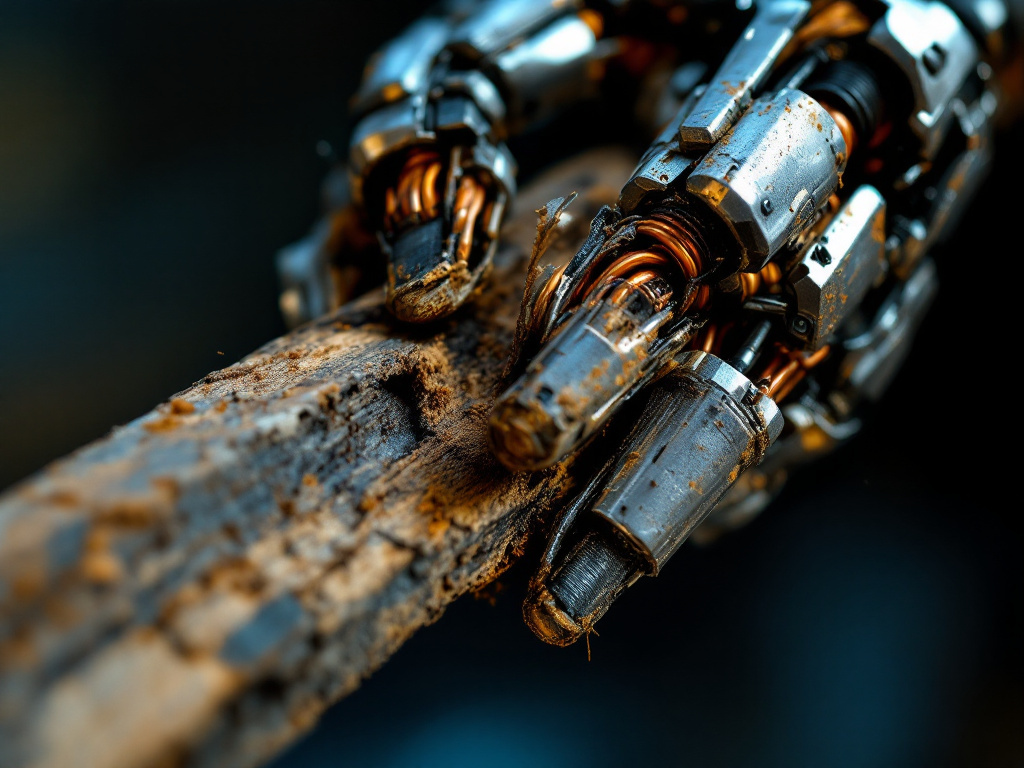
The humanoid robotics sector demands that the future refuse to accommodate any nostalgia for human inefficiency. Yet, this future cannot survive on theoretical physics alone. Selling a titanium hand to replace the worker who sweeps the factory floor, and then systematically lying about the hand's ability to hold a broom, is not innovation. It is a calculated financial maneuver designed to extract capital before the physical reality of the technology is exposed. Until the massive chasm between the cloud ecosystem and the concrete floor is bridged, the humanoid robot remains nothing more than a ten-million-dollar beta test, perpetually tripping over its own feet while the human worker quietly finishes a cold egg sandwich and returns to the line.